


Blind Spots and Road Safety in South Africa: How Drivers Can Protect Vulnerable Road Users
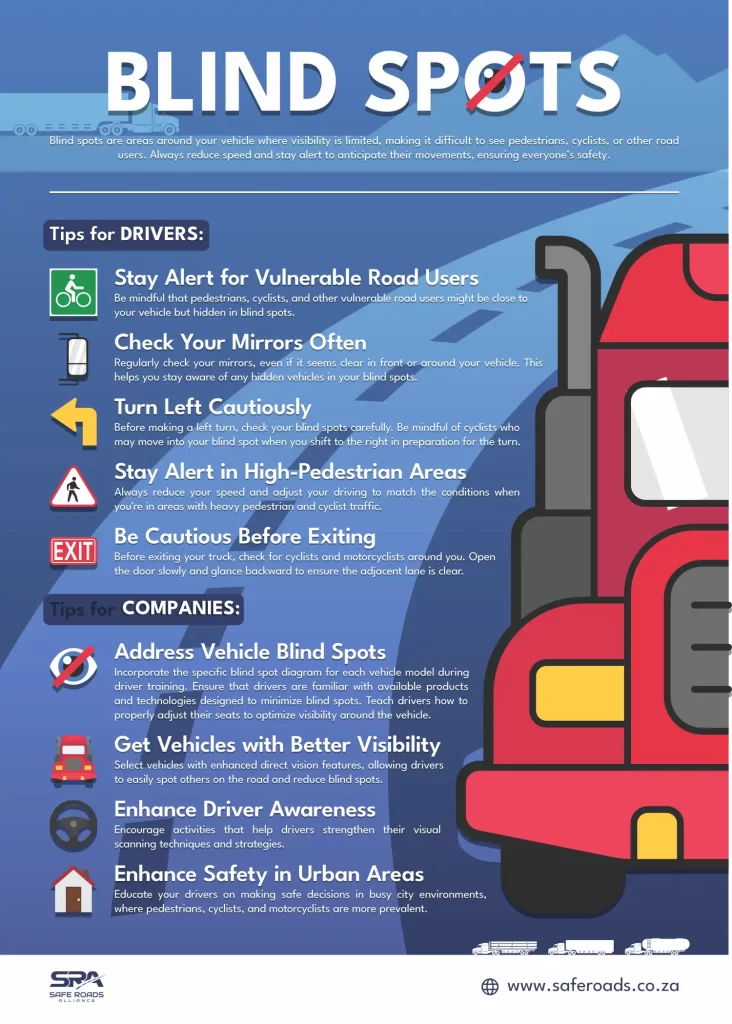
Blind spots are one of the most underestimated dangers on the road. They are the areas around a vehicle where the driver’s visibility is limited, making it harder to see pedestrians, cyclists, motorcyclists, and even other vehicles. On page 1, the SRA (Safe Roads Alliance) Blind Spots poster explains this clearly and urges drivers to reduce speed, stay alert, check mirrors often, turn cautiously, and take extra care in busy pedestrian areas. It also calls on companies to improve vehicle visibility, strengthen driver awareness, and train drivers on vehicle-specific blind spots.
This matters even more in South Africa, where vulnerable road users face a very high level of risk. Arrive Alive’s 2023 State of Road Safety report says pedestrian fatalities made up 45.11% of road deaths in South Africa that year, showing why drivers need to pay close attention to people outside the vehicle, especially in towns, cities, delivery zones, school areas, and busy roadside environments.
For SRA, blind spot awareness is not just a driving tip. It is a road safety priority. Better mirror use, better scanning, better vehicle design, and better training can all help reduce preventable crashes.
What Are Blind Spots?
Blind spots are the spaces around a vehicle that the driver cannot see clearly through the mirrors or direct line of sight. Arrive Alive explains that every vehicle has blind spots, and that poor mirror positioning can make them bigger and more dangerous. Its recent guidance also notes that in urban environments, blind spots can hide cyclists riding close to the edge of the road, motorcycles filtering through traffic, and vehicles approaching quickly from behind.
Arrive Alive also points out that visibility problems are not only about side mirrors. Vehicle structure, including pillars, can block part of the driver’s field of view, which is why active scanning is so important when approaching junctions, turning, changing lanes, or pulling away.
That is why the SRA poster focuses so strongly on awareness. Drivers cannot respond to what they do not see.
Why Blind Spot Awareness Matters for Vulnerable Road Users
The people most at risk in blind spot incidents are often the least protected. Pedestrians, cyclists, and motorcyclists do not have the protection of a vehicle body around them, which means even a low-speed collision can have serious consequences. Arrive Alive notes that cyclists are harder to see in traffic and that speed plays a major role in injury severity.
Arrive Alive also warns that the blind spot next to the side of a truck is a particularly dangerous area for vulnerable road users such as pedestrians and cyclists. In its truck blind-spot awareness content, it stresses that many people simply do not realise how much a truck driver cannot see.
This gives important context to the SRA message. Blind spot safety is not only about protecting other motorists. It is about protecting the most vulnerable people on South African roads.
SRA Tips for Drivers: How to Reduce Blind Spot Risk
Stay alert for vulnerable road users
The SRA poster tells drivers to stay alert for pedestrians, cyclists, and other vulnerable road users who may be close to the vehicle but hidden in blind spots.
That advice aligns closely with Arrive Alive guidance, which reminds drivers to stay especially aware of motorcyclists, cyclists, and other road users who may not be immediately visible when changing lanes or moving through traffic.
In practice, this means looking beyond the obvious. In urban traffic, near schools, around shopping centres, at taxi stops, and in residential streets, assume that someone could be beside your vehicle even if your first glance does not pick them up.
Check your mirrors often
SRA advises drivers to check mirrors regularly, even when the road ahead seems clear.
Arrive Alive supports this by explaining that mirrors are essential for awareness, not only for parking or reversing. It says correctly adjusted mirrors help drivers detect approaching traffic, reduce blind spots, and spot cyclists or motorcycles sooner. It also recommends checking blind spots by turning your head over your shoulder before changing lanes, passing, turning, or opening your door next to traffic.
Mirror checks should become automatic. A quick scan of your rear-view and side mirrors, followed by a proper blind-spot check, can prevent a serious collision.
Turn left cautiously
On page 1, SRA tells drivers to turn left cautiously and be mindful that cyclists may move into a blind spot when the vehicle shifts right in preparation for the turn.
Arrive Alive gives similar warnings around large vehicles and cyclists. Its cycling safety guidance says riders should avoid passing slow-moving trucks or buses on the inside because large vehicles may move outward before turning, and truck safety guidance explains that trucks often need extra room to complete wide turns safely.
For drivers, the lesson is clear: signal early, slow down, check mirrors, check the blind spot again, and never assume the inside is clear just because you did not see a cyclist a few seconds earlier.
Slow down in high-pedestrian areas
The SRA poster tells drivers to reduce speed and match conditions in areas with heavy pedestrian and cyclist traffic.
This is especially important in South Africa, where pedestrian safety remains a major challenge. Arrive Alive’s state report says pedestrian safety is still the country’s most significant road safety issue and records pedestrians as a very large share of national road fatalities.
Lower speed gives you more time to identify hidden hazards, respond to sudden movement, and avoid turning a near miss into a tragedy.
Be cautious before exiting
SRA also reminds drivers to check for cyclists and motorcyclists before getting out of the vehicle, open the door slowly, and glance backward to make sure the adjacent lane is clear.
Arrive Alive gives matching advice in its blind-spot safety guidance, recommending that drivers check over their shoulder before opening a door when parked next to traffic.
This is a simple habit, but it matters. A careless door opening can seriously injure a passing cyclist or motorcyclist.
SRA Tips for Companies: What Fleets and Employers Should Do
Train drivers on vehicle-specific blind spots
The SRA poster urges companies to use the blind spot diagram for each vehicle model during training and to teach drivers how to adjust their seating for the best possible visibility.
That approach is well supported by Arrive Alive, which notes that every vehicle has blind spots and that seat position and mirror setup directly affect driver awareness, comfort, and reaction time. Proper driving position also helps reduce fatigue and improves control.
For fleet operators, this means training should never be generic. A delivery van, rigid truck, articulated truck, and passenger vehicle all have different visibility challenges.
Choose vehicles with better direct vision
SRA recommends selecting vehicles with better direct-vision features so drivers can more easily spot others on the road and reduce blind spots.
Arrive Alive also points to technology and mirror-based solutions that can help reduce blind spot risk, including better mirror systems and blind-spot monitoring technologies.
For companies managing fleets, vehicle specification is a safety decision. Better visibility can make a meaningful difference in busy urban conditions where people on foot and on bicycles are close to moving vehicles.
Strengthen visual scanning and awareness
SRA encourages companies to help drivers improve their scanning techniques and general awareness.
That fits with Arrive Alive’s broader defensive driving advice, which says drivers should actively scan, check mirrors, verify blind spots before manoeuvres, and avoid lingering in areas where another driver cannot see them.
Awareness is a skill that can be trained. The more consistent the scanning habit, the less likely a driver is to miss a vulnerable road user moving into danger.
Focus on urban driving safety
SRA also tells companies to educate drivers on making safer decisions in busy urban environments where pedestrians, cyclists, and motorcyclists are more common.
Arrive Alive’s recent guidance highlights that urban blind spots can hide cyclists, motorcycles, and fast-approaching vehicles, while its lane-changing advice reminds drivers to remain alert to vulnerable road users during everyday traffic movement.
City driving requires more than technical skill. It requires patience, anticipation, lower speeds, and a constant awareness that someone smaller and less visible may be nearby.
Final Thoughts
The SRA Blind Spots poster delivers a strong and practical road safety message: blind spots can hide danger, but smart habits can reduce risk. Its advice to drivers and companies is clear, relevant, and highly practical for South African roads.
For SRA, safer roads start with better awareness. When drivers look properly, slow down, and respect the space around their vehicles, they help protect the people who need that protection most.
- The ABCs of Defensive Driving in South Africa
- Understanding Speed Limits in South Africa: Why Speed Awareness Saves Lives
- Tyre Condition and Road Safety in South Africa: Why Your Tyres Matter More Than You Think
- Safety Belt Rules in South Africa: Why Buckling Up Saves Lives
- Road Signs in South Africa: Why Understanding Them Saves Lives
Review
85%
The SRA poster tells drivers to stay alert for pedestrians, cyclists, and other vulnerable road users who may be close to the vehicle but hidden in blind spots. The SRA Blind Spots poster delivers a strong and practical road safety message: blind spots can hide danger, but smart habits can reduce risk. Its advice to drivers and companies is clear, relevant, and highly practical for South African roads.